Bedding Guide
Inside Gingerlily’s Seasonal Insert Range: Matching Warmth to Your Climate
A comforter’s job sounds simple: keep the sleeper warm. In practice, the ideal insert must negotiate with the room, the season, the sleeper’s habits, and the sometimes incompatible preferences of whoever shares the bed. Gingerlily’s seasonal range offers distinct summer, all-season, and winter weights, alongside details such as shell fabric and fastening points that can make a quiet difference night after night.
Published November 21, 2026
Warmth is a relationship, not a number
It is tempting to think of a comforter as a fixed quantity of warmth: light, medium, or heavy, as if the bedroom were a laboratory and the sleeper a constant. But warmth is relational. It depends on the temperature of the room, the breathability of the bedding around the insert, the sleeper’s own heat, and even the difference between a house that cools sharply at night and one that holds the day’s warmth until morning.
That is why seasonal bedding is less about matching a calendar than matching conditions. A summer-weight insert may be useful through much of the year in a well-insulated apartment or for someone who sleeps hot. A winter insert may be necessary in an unheated bedroom even before the season officially changes. Between those poles is the all-season option: a middle course for rooms and sleepers whose needs do not move dramatically from month to month.
Gingerlily’s range makes those distinctions tangible through different fill weights. The stated tog equivalents provide a useful point of comparison: its summer-weight silk-filled comforter is described as approximately 2–4 tog, while the winter-weight option is approximately 9–11 tog. The all-season models are presented as year-round choices, though a specific tog equivalent is not supplied for every construction. These figures indicate intended insulation, not a promise that every sleeper will experience precisely the same warmth.
First, read the room
Before choosing a summer, all-season, or winter insert, spend a little time noticing the bedroom itself. Does it stay cool after the heating goes off? Does afternoon sun leave the room warm well into the night? Is there effective ventilation? Is the bed tucked beneath an exterior wall, near a draughty window, or in a top-floor room that gathers heat?
These observations are more useful than a broad description of the local climate. Two people in the same city can have sharply different sleeping environments. One may live in a shaded, draft-prone room and welcome substantial insulation; another may sleep in a centrally heated apartment where a heavy insert feels excessive in January. Climate matters, but the indoor microclimate is the one the comforter actually meets.
Personal preference belongs in the calculation, too. Some sleepers like a substantial layer over the body; others find weight or trapped heat distracting. People who wake warm may prefer a lighter insert even in a cold season, especially if the bedroom itself is heated. Those who tend to feel cold may want additional insulation or a flexible arrangement that lets them adapt without replacing the entire bed.
- Choose for the bedroom: consider typical nighttime temperatures, ventilation, heating, and how quickly the room cools.
- Choose for the sleeper: account for whether you usually feel warm or cold under bedding.
- Choose for the bed: consider whether the insert will be used alone, under a cover, or layered with another comforter.
The summer insert: light insulation for warm nights
A summer insert is not necessarily a blanket for heat waves. It is a lighter insulating layer for nights when a thick comforter would retain more warmth than the sleeper wants. The Gingerlily summer-weight silk-filled comforter is described as a 2–4 tog equivalent, with pure long-strand mulberry silk filling and a cotton sateen shell. That combination offers a distinct balance: silk in the filling, cotton against the room and beneath the duvet cover.
Silk fill is valued in bedding for its lightness and its capacity to help manage heat and moisture. The point is not that it makes every bed cool in every circumstance. Rather, the material can offer warmth without the same bulky feel as a more heavily insulated insert. In a warm bedroom, or for someone inclined to overheat, the difference between light warmth and substantial loft can be meaningful.
The cotton sateen shell contributes its own character. It provides a smooth, closely woven casing around the silk fill, while the duvet cover—if used—adds another layer between the insert and the sleeper. Small ties and corner fastenings are worth checking, since they help keep the comforter from slipping or bunching inside its cover. Gingerlily’s summer option also has corner loops, making it easier to secure in place.
For a closer look at the specifications, see the Gingerlily summer-season silk-filled comforter. It is listed with a cotton sateen shell, pure long-strand mulberry silk fill, and a 2–4 tog profile. If the room is warm for most of the year, this lighter construction may serve beyond summer. If the room turns sharply cold in winter, it can instead be part of a seasonal rotation.
All-season warmth: a steady middle ground
An all-season insert is often the sensible choice when the bedroom does not experience severe temperature swings, when storage space is limited, or when the sleeper would rather avoid a twice-yearly bedding change. Its appeal lies in continuity: one insert for much of the year, with a duvet cover and other layers adjusted as the room changes.
Gingerlily’s all-season silk-filled comforters appear in more than one shell construction, an important distinction when comparing products. One version uses mulberry silk fill inside a cotton sateen shell; another pairs silk fill with a silk shell. The latter construction is described with a 16-momme charmeuse silk outer shell, Grade 6A long-strand mulberry silk filling, piping, and corner loops. The cotton-shell option has a 300-thread-count cotton sateen casing. Neither shell should be treated as an afterthought: it affects the surface feel, the overall construction, and the care routine.
Shell material does not, on its own, determine how warm the insert will feel. The amount and arrangement of the fill, the shell’s structure, and the bedding layers around it all contribute. A silk shell may appeal to someone who wants the silk experience to extend beyond the filling; a cotton shell may suit someone who prefers a familiar, practical casing. Look at the whole specification, rather than assuming that one fabric is automatically warmer or cooler.
See the all-season silk-filled comforter with a cotton sateen shell for one example. A different construction is the all-season silk-filled comforter with a silk shell, which combines a silk outer with long-strand mulberry silk fill. Comparing those two models illustrates why the phrase “silk comforter” is not a complete description: shell and fill are separate parts, and each deserves attention.
The winter insert: more insulation, still a question of comfort
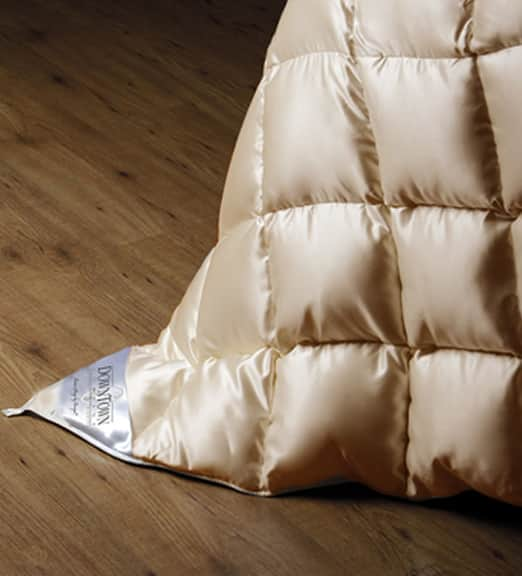
When a bedroom grows cold at night, a winter-weight insert provides more substantial insulation. Gingerlily’s winter-season silk-filled comforter is listed at approximately 9–11 tog, with pure long-strand mulberry silk fill and a cotton sateen casing. Its buttons and small ties at the sides and corners are designed to help connect it with another comforter when a sleeper wants additional warmth or a more tailored layering arrangement.
The jump from a 2–4 tog summer profile to a 9–11 tog winter profile is a useful shorthand for the difference in intended warmth. It is not a guarantee of how warm the bed will feel in any given home. A winter insert under a heavy duvet cover in a heated bedroom may feel warmer than expected; the same insert in a cold room may feel just right. Tog is a guide to insulation, not a substitute for considering the surrounding layers and the sleeper’s own habits.
Silk’s lighter drape may also matter to people who want warmth without the sensation of a dense, heavy covering. But preference is personal. Someone who enjoys a lofty, substantial bed may prefer a different kind of fill or construction; someone who wants warmth with less bulk may appreciate the character of a silk-filled insert. The relevant question is not whether one material is universally superior, but whether its particular combination of warmth, weight, and handling suits the sleeper.
The Gingerlily winter-season silk-filled comforter provides the clearest reference point in the seasonal range: a 9–11 tog equivalent, silk fill, cotton sateen shell, and attachment details for combining or securing layers. Its care guidance is also more involved than simply washing a duvet cover, so it is sensible to review those instructions before purchase.
A divided bed, a shared comforter
Couples do not always agree about temperature. One person may kick off the bedding while the other reaches for another blanket; the result can resemble a small domestic negotiation conducted entirely in the dark. A half-and-half insert offers a practical alternative to choosing one compromise weight for both sleepers.
Gingerlily’s half-summer, half-all-season silk-filled comforter divides the bed into two different warmth zones: a lighter summer side and a warmer all-season side. The construction is described with a cotton sateen shell, buttons, and ties that can help with layering. This arrangement does not change the temperature of the room, but it gives each sleeper a different insulation level on their own side of the bed.
For households whose needs vary by season as well as by person, that split construction may be especially useful. It also demonstrates why matching warmth is not always a matter of selecting a single number. The half-summer, half-all-season comforter presents a more individualized approach: one shared bed, two different preferences, and a way to adjust without maintaining separate full-size bedding on each side.
The useful details: shell, ties, buttons, and cover
Product descriptions often give the fill top billing, but a few construction details are worth reading with equal care. First, identify the shell material. Cotton sateen and silk feel different, and a shell made from one fiber should not be confused with a comforter filled with that same fiber. A comforter may have silk fill and a cotton shell, or silk fill and a silk shell; those are separate specifications.
Next, look for corner loops, side ties, and buttons. A duvet cover can shift around an insert during the night, leaving a lump at one end and an empty expanse at the other. Fastenings help reduce that wandering. They can also make it possible to join or layer compatible inserts, although the exact method depends on the product’s design. Check the supplied instructions rather than assuming that every set of ties or buttons will connect to another model.
Consider whether a duvet cover is part of your plan. A cover protects the insert from routine contact and can be laundered more frequently than the comforter itself. It also changes the feel of the bed, since the sleeper is encountering the cover’s surface rather than the insert’s shell. If a comforter is designed to be used with a cover, the loops and ties become particularly useful; if it can be used on its own, its shell and care requirements become more directly relevant.
Finally, compare care instructions before settling on a seasonal weight. The summer and winter silk-filled models have guidance that may include spot cleaning or professional laundering, while the silk-shell all-season model is described as needing airing and spot cleaning rather than washing or dry cleaning. Instructions vary by construction. A product that matches a climate but conflicts with the household’s care routine may not be the right choice after all.
A simple way to choose
When the options begin to blur together, start with the most common nighttime condition, not the most extreme one. If the room is usually warm and you prefer little insulation, begin with the summer weight. If temperatures are moderate and fairly stable, consider an all-season insert. If the bedroom is cold for long stretches or you habitually feel chilly, examine the winter weight. Then adjust for whether you sleep hot or cold, what cover you intend to use, and whether you expect to add layers.
- For warm rooms or warm sleepers: consider the 2–4 tog summer-weight option, particularly if a heavier insert tends to feel stifling.
- For moderate, changeable conditions: compare the all-season models, paying close attention to whether the shell is cotton sateen or silk.
- For cold rooms or cold sleepers: consider the 9–11 tog winter-weight option, while accounting for heating and the duvet cover.
- For different preferences in one bed: consider the divided summer/all-season construction or another arrangement that allows independent layering.
It can help to keep a short record for a week: approximate room temperature at bedtime, whether you wake too warm or too cold, and which layers were on the bed. The point is not to turn sleep into an experiment with charts and conclusions. It is simply to replace guesswork with a few observations. A comforter chosen for the room you actually sleep in is more likely to feel right than one chosen for an abstract idea of the season.
A quieter kind of seasonal change
Seasonal bedding is sometimes imagined as a full wardrobe exchange: a thick comforter hauled into storage, a lighter one brought out, and a brief period in which the linen cupboard seems to contain more bedding than the bed can reasonably hold. A thoughtful insert choice can make that transition less dramatic. Some people keep a summer and a winter weight; others use an all-season insert and adjust the cover or add a removable layer when the weather turns.
There is no single arrangement that suits every home. The useful distinction is between warmth levels, not between a “right” and “wrong” way to make a bed. Gingerlily’s summer, all-season, and winter inserts offer a structured way to compare those levels, while the shell fabrics and fastening details help clarify how each piece will function once it is in use.
Start with the room, then the sleeper, then the construction. The tog equivalent can narrow the field; the shell, ties, buttons, and care instructions can help make the final decision. When those details line up with the conditions of the bedroom, the comforter has less work to do—and the sleeper may have less reason to wake in the middle of the night to renegotiate the covers.